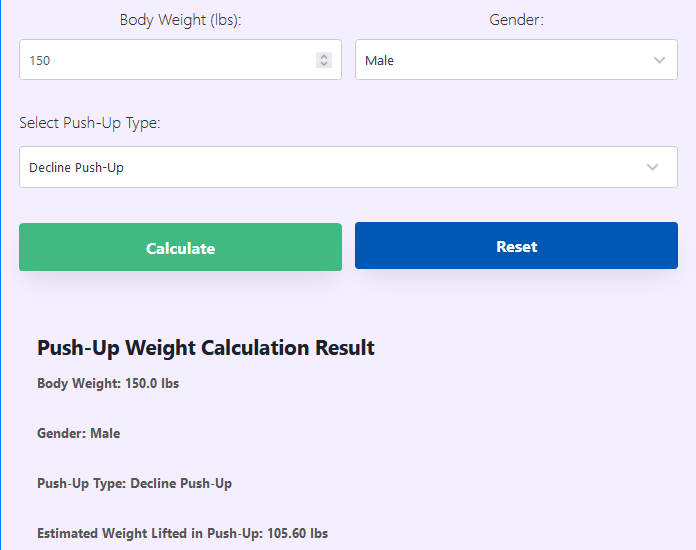
Because ignorance is bliss, but calibrated ignorance is progress. You might think you are moving a heavy boulder, but the calculator can prove you are actually just nudging a medium-sized pumpkin. This is the first step in not hating yourself during a workout.
Let me give you an example from my own sweaty, humiliating past. I used to do push-ups in the park. I felt like a God—beads of sweat, forearms tense. I thought I was moving 180 pounds. I plugged 180 pounds into a Push-up Weight Calculator, feeling proud. The calculator said, “You lift 115 pounds.” It took a moment. That’s not even the weight of a large adult human. That’s the weight of a huge box of cat litter.
I had been celebrating my victory over two bags of cat litter. It changes your perspective, doesn’t it? Suddenly, you stop slapping your own back and start wondering if your cat is mocking you.
How to Use It (Without Crying)
First, find your honest weight. Not your “doctor’s scale with clothes on” weight. Your real weight. The one you see when you step on the scale after a long weekend. Type that number into the calculator. It’s a brave act of self-acceptance.
 The Vsique Push-Up Trainer
Second, choose your style. Are you a Stop-and-Go standard push-up person? Or are you a Knee-drop breath-saver? The calculator loves both. It doesn’t judge. It just spits out a number. For a 200-pound person, a standard push-up moves 128 pounds. For a 150-pound person, it moves 96 pounds. That is the weight of a medium-sized golden retriever. You are basically bench-pressing a happy dog, repeatedly.
Third, compare it to real life. That 96 pounds? That’s the weight of your new washer/dryer. That 128 pounds? That’s your roommate’s cousin who fell asleep on your couch last Thanksgiving. When you realize you are pushing a sleeping relative off the floor, you suddenly feel a lot more powerful.

