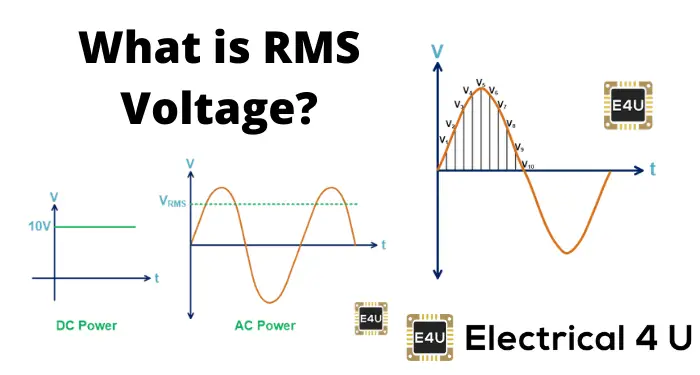
Picture this: you’re sitting on your couch, flipping on a desk lamp. The bulb glows steadily—no flickering, no sudden dimming. But here’s the weird part: the electricity flowing into that lamp is actually pulsing back and forth 50 or 60 times per second. It’s like a wave that goes up, down, and then reverses direction. Our poor little lightbulb, however, doesn’t care about direction—it just wants enough power to stay bright.
So how do we describe the “oomph” of a wave that’s constantly changing? If we just said “the voltage is 120 volts,” that would be misleading—because the voltage is never 120 volts at any single instant. It’s swinging between 0 and a peak of about 169 volts. That’s where RMS voltage steps in like a superhero with a calculator.
RMS stands for something boring, but the idea is brilliant
RMS stands for Root Mean Square, which sounds like a villain from a math-themed sci-fi movie. But don’t let the name scare you. The RMS value is basically the equivalent DC voltage that would deliver the same power to a device. Think of it like this: if you had a toaster running on steady DC power, and another toaster running on AC with an RMS voltage of 120 volts, they’d both toast your bread exactly the same way.
It’s like comparing a steady jogger to someone who sprint-and-rests across a park. The jogger maintains a constant speed, while the sprinter has moments of zoom and pause. RMS voltage measures the average “oomph” of that sprinter, so you know they’re covering the same distance as the jogger. Neat, right?