
Before we dive into the numbers, meet your two new best friends: the Right-of-Use (ROU) Asset and the Lease Liability. They’re like peanut butter and jelly, but for accountants. The liability is the total amount of future lease payments you owe (present valued, because we’re fancy). The ROU asset is the value of your right to use that space or equipment for the lease term.
Every journal entry will involve these two. They’re the duo that never breaks up, unless you terminate the lease early — which is basically the accounting equivalent of a messy divorce.
Example Time: Renting a Cool Office Space
Let’s say your company, “Creative Widgets Inc.,” signs a 5-year lease for a trendy office space. The total lease payments are $120,000. You start using the space on January 1st. The first step? Recording the lease commencement — it’s the accounting version of moving day.
First, calculate the present value of those payments. For simplicity, let’s say it’s exactly $120,000 (ignore the nerdy discount rate for now). Your entry looks like this:
Debit: Right-of-Use Asset $120,000
Credit: Lease Liability $120,000
Congratulations! You just put a giant invisible asset and liability on your books. Don’t worry, no one can see it unless they know where to look — like a financial version of a secret handshake.
Month One: The First Payment
Now it’s time to pay the landlord. Mr. Landlord wants his $2,000 for the month. But you can’t just throw the whole payment against the liability. Oh no, that would be too easy. You have to split it into two parts: interest and principal. Think of it like a mortgage for office chairs.
Let’s assume the interest for month one is $400 (because accounting loves round numbers). Your journal entry is:
Debit: Lease Liability $1,600
Debit: Interest Expense $400
Credit: Cash $2,000
See? The cash goes out the door, the liability shrinks a little, and you recognize the cost of borrowing. It’s like paying for pizza and realizing you also tipped the delivery driver — the delivery driver is interest here.
Amortization: The Quiet Sibling
But wait, there’s more! That ROU asset doesn’t just sit there forever. It slowly gets used up, just like the shine on a new car. This is called amortization (depreciation for intangible friends). For a straight-line lease, you’ll expense a chunk of the asset each month.
In our example, the total asset is $120,000 over 60 months (5 years). That’s $2,000 per month. The entry is simple:
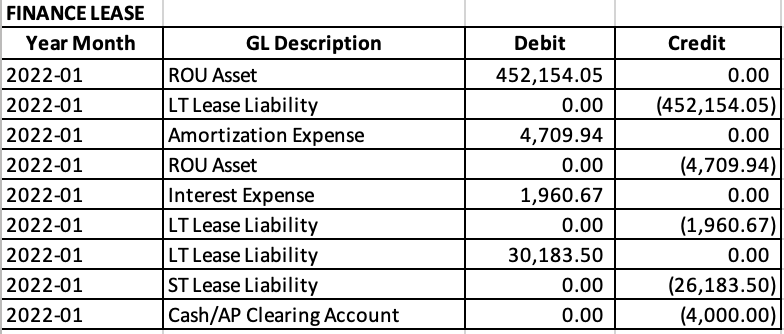 Understanding Journal Entries for Lessees under ASC 842
Debit: Amortization Expense $2,000
Credit: Right-of-Use Asset $2,000
Your ROU asset is now shrinking. It’s like watching your favorite candle burn down — except it’s a legal document on fire.

