
Here’s the confusion trap. In algebra class, we learn that the standard parabola equation is y = x². Its axis is the Y-axis (x=0). So your brain whispers, “Axis = Y, right?” Wrong move, brain.
The Y-axis is just one specific line. But the axis of symmetry is a concept, not a fixed buddy. It’s like asking, “Is the president’s name Joe or Bob?” You’re missing that it changes every election cycle.
When your teacher says “axis of symmetry,” they’re asking for the line. Not the letter. And that line is almost always a vertical line in the form x = something.
Let Me Break It Down With a Smile
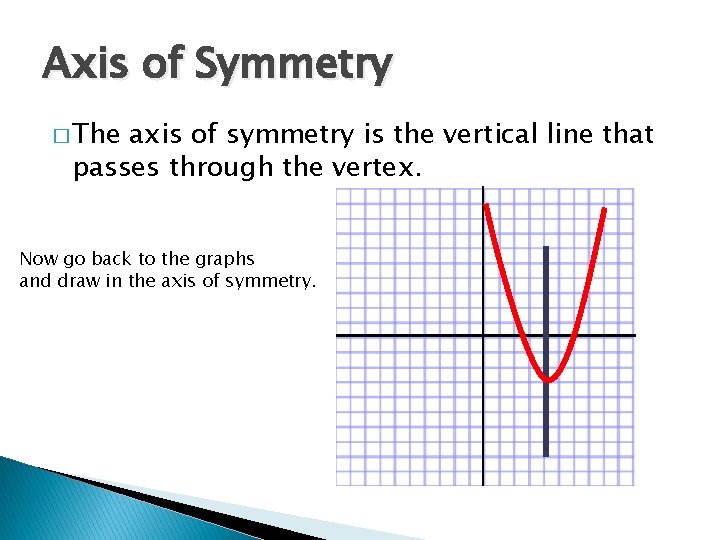
Picture a happy, U-shaped parabola. It opens upward or downward. The highest or lowest point—the vertex—sits dead center. Draw a vertical line through that vertex. That is your axis of symmetry.
So if the vertex is at (3, 5), your axis is x = 3. Not Y. Not X. Just a number wearing an X jersey. The poor Y-axis is just a bystander here.
 Investigating Characteristics of Quadratic Functions Part 1 What
Now, what if the parabola opens sideways? Like x = y²? Then the axis of symmetry is a horizontal line, y = something. But honestly? Those sideways parabolas in high school math feel like a trick question. Most of the time, we stick with vertical ones.

