
Step 1: Identify a and b from your equation. If you see something like y = -3x² + 6x + 2, then a = -3 and b = 6. Don’t let the negative signs scare you—they’re just drama queens too.
Step 2: Plug into x = -b/(2a). For our example: x = -6 / (2 * -3) = -6 / -6 = 1. So x = 1. That’s your line. Write it down like a trophy: x = 1.
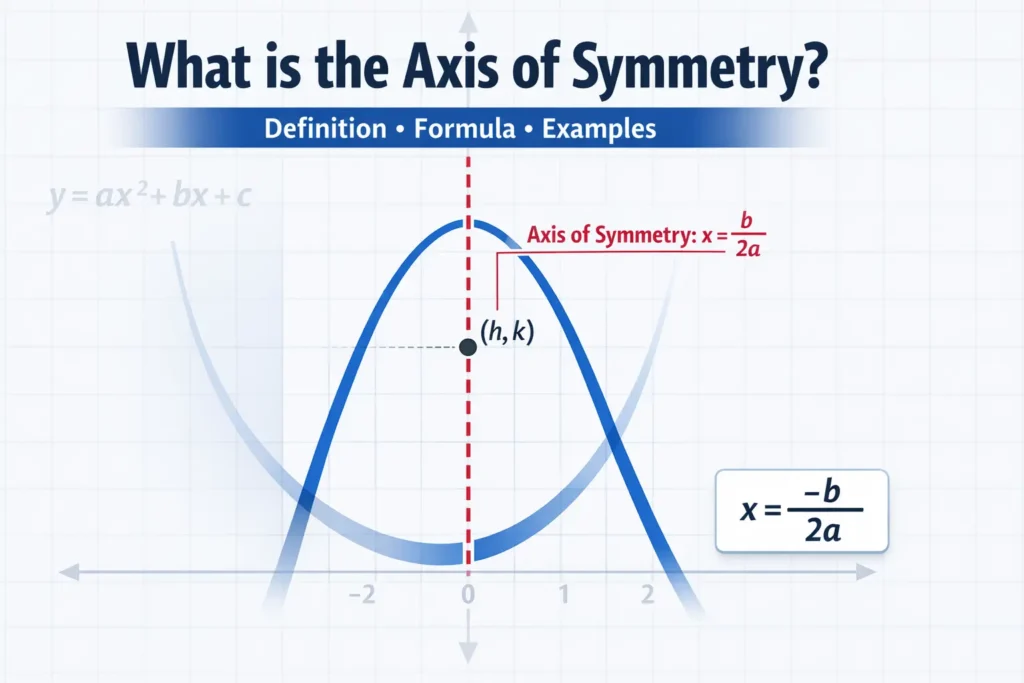 What Is The Axis Of Symmetry? Definition And Examples
Step 3: Celebrate. Seriously. You just found the spine of the parabola. Now you can also find the vertex by plugging that x-value back into the original equation. But that’s a story for another coffee break.
Quick sanity check: If your a is positive, the parabola smiles (opens upward). If a is negative, it frowns (opens downward). The axis always passes through the highest or lowest point—the vertex. So your line is the center of emotion for the parabola.
What If the Equation Is Already in Vertex Form?
Lucky you! Vertex form looks like y = a(x – h)² + k. The axis of symmetry is just x = h. Straight from the “h” column, no math required. It’s like the universe saying, “Here, have a shortcut.”
For example, in y = (x – 3)² + 5, the axis is x = 3. Done. You can now go back to scrolling memes.
But wait— what if you see y = (x + 2)² – 1? Don’t panic. The “+2” means h is actually -2. So axis = x = -2. Remember, vertex form is sneaky like that—it’s always (x minus h).

